Trading info for action, stop asking God to do stuff for you, touching grass with Andrew Yang, fitness for what matters, a phone-free morning challenge, an outdoor workout, & summer chicken bowls
I’ve launched a premium subscription to The Better Way. You can learn more and opt in to that here.
An important thing to note, you will continue to receive essays and The Weekly email as a part of the FREE subscription.
In The Better Way Weekly
Article Review
Book Summary
Podcast Recommendation
Just Good Content
Weekly Challenge
Workout of the Week
Recipe of the Week
✅ ARTICLE
Tim Denning calls information overload “the new pandemic.” We are drowning in podcasts, programs, protocols, and 20-minute videos about the perfect morning routine. But somehow, we are no less stuck than before.
His diagnosis is that gathering information feels like progress because it pays out the same dopamine as actually doing the thing. Reading about training feels like training. Planning the new diet feels like eating better. It’s the reward without the rep. And the cure isn’t a better source of information — it’s acting on what you already know, letting your own experience (including the failures and the embarrassment) become the teacher.
I see this constantly in the gym. Nobody walking through our doors is one more piece of information away from being healthy. They’re one decision away, repeated for a few months. You almost certainly already know what to do. The better way is to go do it.
“Dopamine from information gathering is a dangerous drug. It’s the dopamine from reading, planning, or learning, but never doing.” — Sahil Bloom, quoted in the piece
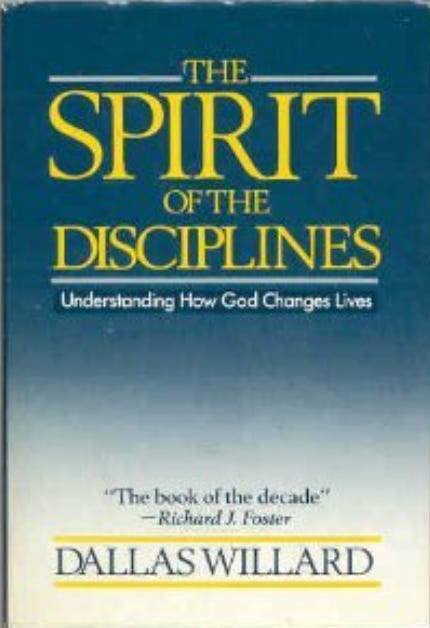
Willard’s argument is simple: Transformation happens the way it happens for an athlete — through training, not trying. The spiritual disciplines (solitude, silence, fasting, sabbath, study, service) are not religious protocols. They’re practices that recondition the whole person, body included, so that doing the right thing slowly becomes natural.
Key Learnings
Grace is opposed to earning, not to effort. Willard’s most famous line, and the hinge of the whole book. Receiving grace doesn’t mean going passive — it means the pressure to earn is gone, so you’re finally free to train.
Your body is where your spiritual life actually happens. Loving God and loving people are things done by a person in a body. Neglect the body and you’ve neglected the only instrument you have for alignment and obedience.
Train ahead of the moment. Nobody runs a marathon on willpower the morning of; they run it on months of unremarkable mornings. The disciplines work the same way.
Disciplines come in two flavors. Abstinence (solitude, silence, fasting, sabbath) breaks the grip of appetite and hurry. Engagement (study, worship, service, fellowship) fills the space with something better.
Why It Resonates
I’ve been chewing for months on the idea that we often assign to the divine what is really due to our lack of discipline … that maybe the anxiety, the inflammation, the noisy inner voice aren’t first and foremost downstream impacts of upstream spiritual issues.
Maybe some of it is just biology we’ve neglected, and the discipline of our bodies is itself a call of obedience. We should not ask God to do for us what He has made us capable of doing ourselves. To respect your biology is to respect the One who built it.
🎬 JUST GOOD CONTENT
"Fitness For What Matters." This helps reframe of why we train, or challenge ourselves, at all. Not for the mirror or the leaderboard, but for the energy, patience, and presence the people in our lives actually need from us.
🎙️ PODCAST OF THE WEEK
The Rich Roll Podcast — “Touch Grass: Andrew Yang Returns to Talk Phone Addiction, AI’s Cognitive Toll, & The Fight for Your Attention”
Rich sits down with Andrew Yang who is an entrepreneur, former presidential candidate, and now founder of Noble Mobile, a phone company that literally pays you to stop doomscrolling.
The conversation is about what our phones are doing to us: the machinery engineered to colonize attention, the cognitive debt we take on every time we outsource thinking to AI, and why willpower was never going to win this fight.
Yang isn’t anti-technology, he’s anti-drift. His argument is that attention is the substrate of everything else in your life, and you either design your environment to protect it or someone else designs it to extract it.
Nobody is coming to hand your attention back to you.
🚀 5 FACTOR CHALLENGE
(Factors of Health | Eat, Sleep, Train, Think, Connect)
Factor: Think
Challenge: The First Thirty. For the next seven days, don’t touch your phone for the first 30 minutes after you wake up.
Why you benefit. The first input of your day sets the trajectory of your attention for the rest of it. Give those minutes to a screen and you start the day reacting to someone else’s news, someone else’s highlight reel, someone else’s emergency. Keep them and you start the day as the author instead of the audience.
💪🏻 WORKOUT OF THE WEEK
“Touch Grass” — no equipment, designed to be done outside. Leave the phone indoors.
4 rounds, for time. Rest 1:00 between rounds. Move at a pace you could hold for a fifth round if you had to.
400m run — out-and-back from your front door; roughly 2 minutes of honest running.
12 burpees — chest to the ground, full hip extension, small jump at the top.
16 jump squats — hips below parallel, land soft, knees tracking over toes.
20m bear crawl — hands and feet, knees an inch off the grass, slow and controlled.
Modifications & Substitutions
Run — sub a brisk 2:00 walk, 90 seconds of high-knee marching, or a bike/row if you have one.
Burpees — step back instead of jumping back, or remove the push-up entirely (up-downs).
Jump squats — sub regular air squats, or squat to a bench or chair.
Bear crawl — shorten to 10m, or sub 30 seconds of plank shoulder taps.
🥑 RECIPE OF THE WEEK
A healthy, nutrient dense, minimally processed meal or snack.
Whisk the olive oil, lime juice and zest, honey, garlic, paprika, salt, and pepper flakes together. Pour half over the chicken thighs and let them marinate 20–30 minutes (reserve the other half as dressing).
Heat a grill or grill pan to medium-high. Grill the chicken 5–6 minutes per side, until cooked through (165°F). Rest 5 minutes, then slice.
While the chicken rests, grill the peach halves cut-side down for 2–3 minutes, until you get char marks and they soften slightly. Slice into wedges.
Build the bowls: rice on the bottom, then greens, sliced chicken, grilled peaches, avocado, and red onion.
Drizzle the reserved dressing over the top, finish with the torn herbs and a pinch of salt.
Serves 4. Keeps well for lunches — store the avocado and dressing separately and add fresh.